Challenge
One Grand Parade remained occupied throughout the refurbishment, therefore making the replacement of the entire heating and cooling system in a single programme impractical. That being said, business continuity was essential, meaning the existing system needed to remain operational while individual areas of the building were upgraded.
A solution was required that would allow each floor to be isolated, decommissioned and refurbished independently. Tenants needed to be temporarily relocated within the building while works took place, before returning to a fully commissioned space.
For Harmon Group, this meant carefully coordinating each stage of the installation around an occupied commercial environment, removing redundant services and installing and commissioning the new system while minimising disruption to tenants and the day-to-day operation of the building.
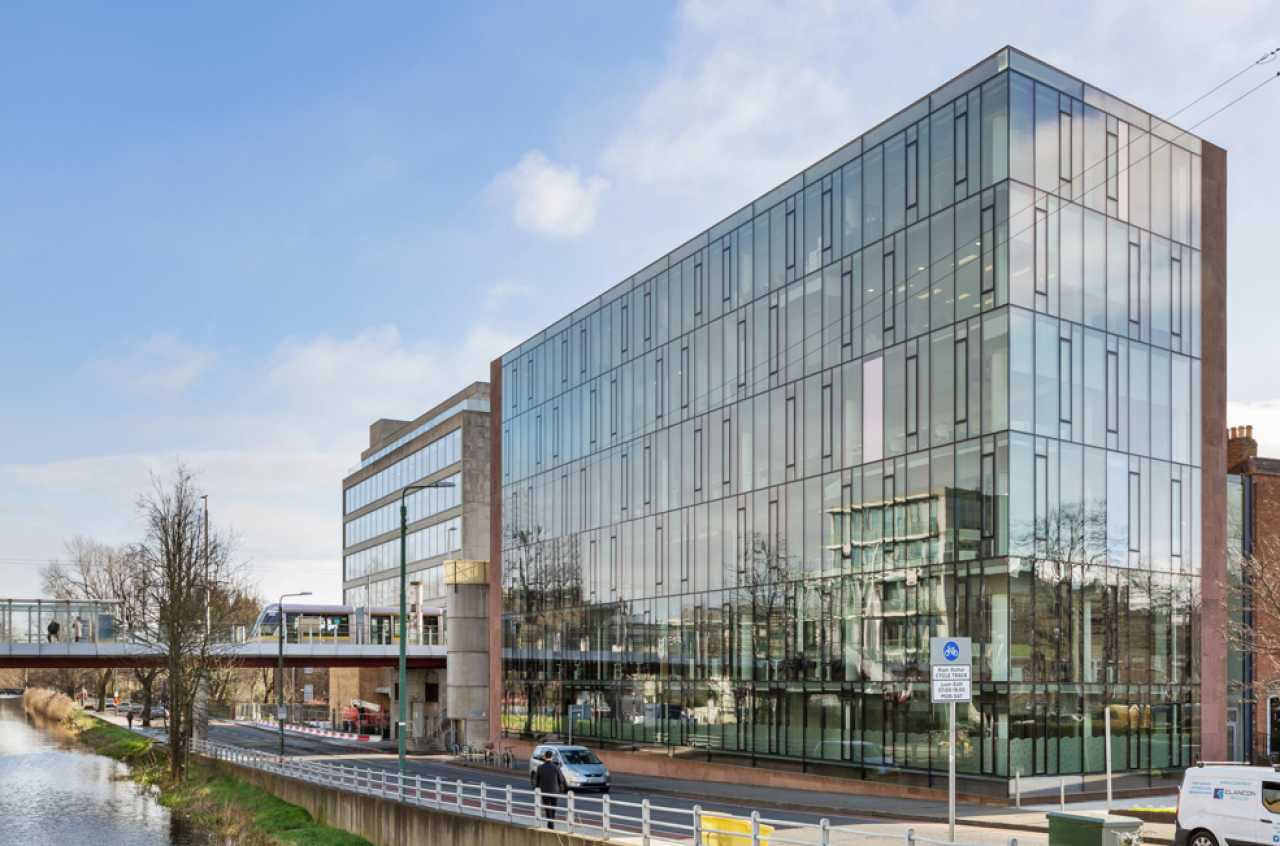
The location of the building presented an additional engineering challenge. Its position immediately adjacent to the Luas rail line, combined with the restrictions of a city-centre site, meant that multiple crane lifts to install new equipment at roof level would have added cost, disruption and complexity to the programme.
At the same time, the new system needed to support the building’s longer-term sustainability objectives. Improved seasonal efficiency, reduced dependence on fossil fuels, responsible refrigerant use and the ability to adapt to future tenant fitouts were therefore central to the design.
Solution
Mitsubishi Electric R32 City Multi Hybrid VRF (HVRF) was selected to provide a flexible, all-electric heating and cooling solution capable of meeting the demands of the phased refurbishment.
The modular nature of HVRF enabled each floor to become a standalone installation within a consistent building-wide air conditioning strategy. Tenants could be moved from a floor, the existing four-pipe fan coil services removed and the new system installed, commissioned and fully operational before occupants returned. Harmon Group delivered the installation on this phased, floor-by-floor basis, creating a practical and repeatable approach that can be carried forward as the remaining areas of One Grand Parade are refurbished.
At the heart of the system is Mitsubishi Electric’s Hybrid Branch Controller (HBC), which enables simultaneous heating and cooling by transferring energy between areas with different thermal demands. Rather than rejecting heat from spaces requiring cooling, the system can redistribute it to areas requiring heating, improving overall energy performance.
A combination of local PAR-U02MEDA touchscreen M-NET controllers and AE-200 central controllers gives occupants control of their immediate environment while providing facilities teams with centralised oversight. Functions including local scheduling, set-point limitation, setback temperatures and integrated PIR occupancy sensors help minimise unnecessary energy consumption without compromising comfort.
Unlike the previous shared central plant arrangement, each tenant can have a dedicated AE-200 controller, providing the opportunity to remotely monitor their environment, configure schedules around occupancy and optimise operation independently of neighbouring tenants.
The challenging site conditions also influenced the equipment layout. To overcome the limitations presented by the restricted site, Harmon Group installed two PURY-EM350YNW Hybrid VRF outdoor units within a naturally ventilated basement enclosure rather than at roof level. Their external static pressure capability of up to 80 Pa enabled condenser discharge air to be safely ducted from the enclosure to atmosphere. This avoided additional roof-mounted equipment and multiple crane lifts beside the Luas line, reducing disruption and installation complexity.
Mitsubishi Electric’s Design Tool software was used to validate the system throughout the design process, confirming indoor unit capacity, refrigerant and water pipework sizing, pipe lengths, height differences and overall compliance with HVRF design parameters.
Harmon Group also retained and integrated existing secondary ductwork and supply air grilles wherever practical, helping to reduce unnecessary material replacement, waste and programme time while accommodating the new HVRF equipment.
The installation incorporates:
- 4 × PURY-EM350YNW high-efficiency Hybrid VRF outdoor units
- 4 × CMB-WM108V-AA 8-port Hybrid Branch Controllers
- 24 × PEFY-WP50VMA ducted Hybrid VRF indoor units
- 4 × PEFY-WP63VMA ducted Hybrid VRF indoor units
- 28 × PAR-U02MEDA touchscreen M-NET room controllers with integrated PIR sensors
- 2 × AE-200 central controllers
- 2 × 5 kW Mr Slim systems serving communications rooms
- 4 × semiconductor-type R32 refrigerant leak detection sensors
Results
Through the phased installation, Harmon Group has been able to modernise its heating and cooling infrastructure of One Grand Parade while keeping the building operational throughout the refurbishment programme. The completed floors now benefit from a flexible, all-electric system that can respond more effectively to individual tenant requirements.
The system has also delivered strong calculated seasonal performance. Mitsubishi Electric’s HVRF SEER and SCOP calculation tool recorded a calculated SEER of 5.18 in cooling and SCOP of 3.85 in heating, demonstrating the efficiency of the selected solution.
Heat recovery provides an additional opportunity to reduce energy consumption by transferring energy between spaces requiring simultaneous heating and cooling. This capability can deliver energy savings of up to 30% compared with standard heat pump systems, contributing to lower operating costs and operational carbon emissions.
The move to R32 refrigerant further supports the building’s environmental objectives. As HVRF uses water as the secondary heat-transfer medium between the Hybrid Branch Controllers and indoor units, it can require up to 40% less refrigerant than an equivalent conventional VRF system. This reduces the building’s overall refrigerant charge while limiting the amount of refrigerant circulating through occupied areas.
Occupant comfort has also been enhanced through more responsive local control, while centralised monitoring provides building and facilities teams with better oversight of system operation. The ability for individual floors and tenants to operate independently makes the building better equipped to accommodate future changes in occupancy and fitout requirements.
Importantly, Harmon Group’s successful delivery of the installation has established a practical template for the next stages of the refurbishment, demonstrating how individual floors can be upgraded and recommissioned while maintaining business continuity across the wider building.
Conclusion
The refurbishment of One Grand Parade demonstrates how a complex, occupied commercial building can transition from traditional central heating and cooling plant towards a more flexible, all-electric solution without requiring a complete building-wide shutdown.
Mitsubishi Electric Hybrid VRF provided the modularity required to deliver the project floor by floor, while heat recovery, R32 refrigerant technology and intelligent controls helped improve energy performance and support the building’s wider decarbonisation objectives.
Central to the successful delivery of the project was close collaboration between Harmon Group and Mitsubishi Electric. Harmon Group’s installation expertise helped translate the project design into a practical solution for a challenging, live commercial environment, from coordinating the phased floor-by-floor works to overcoming the site constraints associated with equipment installation.
The result is a high-quality installation that balances occupant comfort, energy efficiency and operational flexibility while providing a strong foundation for Harmon Group to continue the refurbishment across the remaining floors.